Ryder Xue
Back to research

Independent research · Fragrance & the economy

Consumerism Research

November 2026 edition

This project examines how perfume and beauty spending relate to the economy. Four studies compare US beauty spending with clothing during downturns, measure perfume prices in hours of pay, look for a shift toward sweet, familiar scents in launch descriptions after economic stress, and investigate a split between luxury and budget brands. The data come from government statistics, archived prices, fragrance catalogs and Google Trends.

Results are limited: the main spending and launch tests are inconclusive; two bottles do not show rising costs in work hours; sparse search data leave the market split untested. Catalogs and searches track launches and attention, not purchases. These are separate studies, not one validated index.
Observation dates differ across gauges. The November update adds industry and academic context alongside the registered and exploratory results.

November 2026 research update

The collective reading.

Like a fragrance pyramid, the layers organize signals that move at different speeds. Each keeps its own date and unit; there is no combined score.

Top

Search attention

Barbell search reading unavailable.

Heart

Consumer spending

Small-luxury growth tilt

+0.4 ppObservation: August 2026 · steady

Base

Launch culture & affordability

Gourmand launches vs trend

+3.6 ppObservation: December 2025 · steady

Chanel N°5 EDP · 100 ml

5.9 hoursArchived price snapshot: February 16, 2026 · rising

Dior Sauvage EDT · 100 ml

3.8 hoursArchived price snapshot: August 5, 2021 · steady

Directions compare a one-year change with historical variation. A steady or rising reading describes that series; it does not establish the study’s hypothesis.

01 / Registered study · Working paper

The Lipstick Test

Do small luxuries hold up in a recession?

The primary recession comparison did not establish a small-luxury advantage.

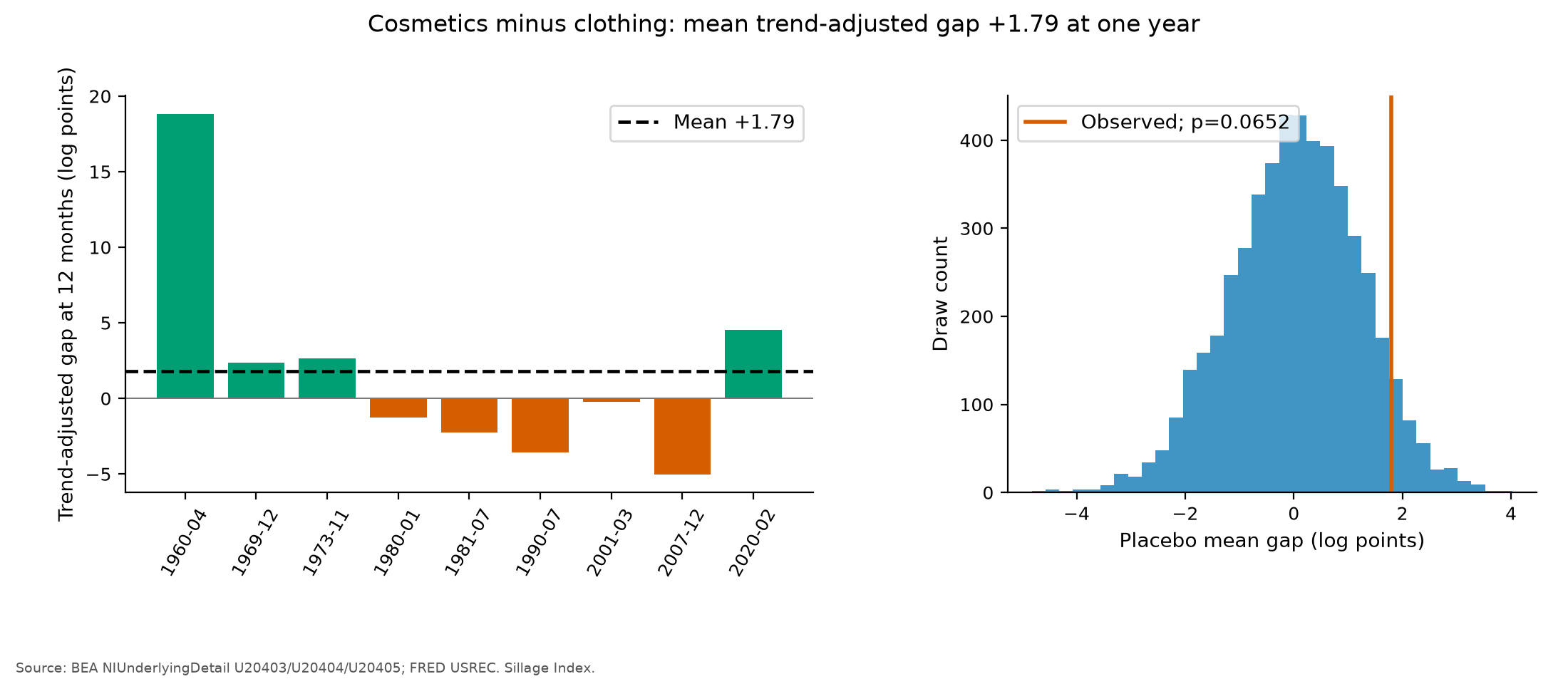
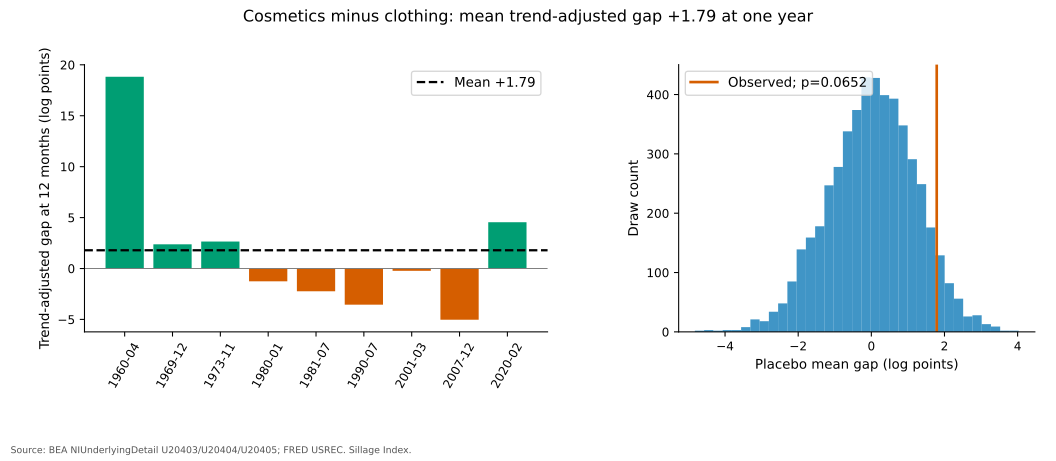
Across nine US recessions, the mean cosmetics-minus-clothing gap was +1.788 log points; the adjusted p-value was 0.0652. Four of nine episode gaps were positive. The category includes cosmetics, perfumes, bath and nail products, so the finding cannot isolate fragrance.

US monthly observations, 1959–August 2026 · nine NBER business-cycle peaks

Latest descriptive reading · cosmetics minus clothing year-over-year quantity growth

Small-luxury growth tilt

+0.4 pp

Observation: August 2026

Explore the evidence

Recession comparison. The registered trend-adjusted comparison across nine recessions. The mean gap is uncertain and does not meet the registered 5% threshold.

The registered trend-adjusted comparison across nine recessions. The mean gap is uncertain and does not meet the registered 5% threshold.

SVG PNG

On a narrow screen, scroll the chart horizontally or open the full-size SVG. The summary below gives the main reading in text.

04 / Historical archive study

Bottle-Hours

How many hours of work buy a bottle?

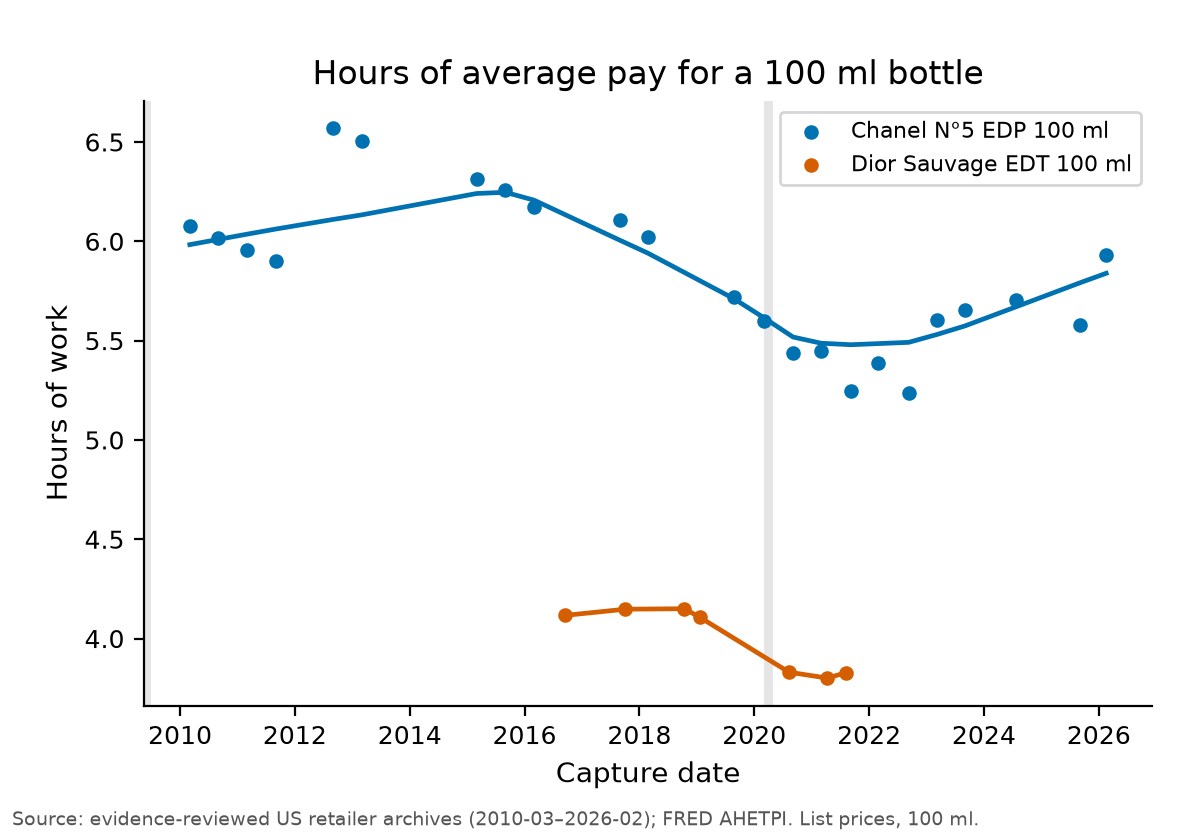
Neither primary bottle series establishes increasing hours of pay to buy a bottle.

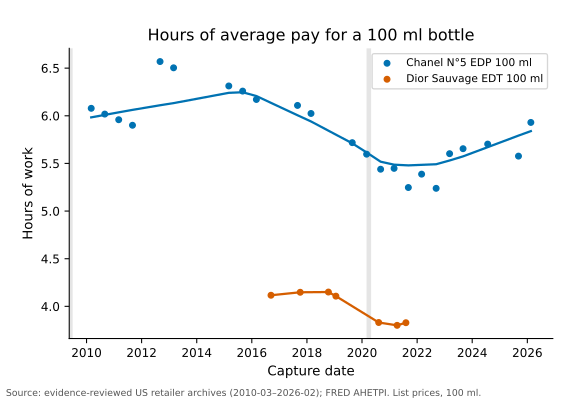
Verified archived prices for fixed 100 ml Chanel N°5 EDP and Dior Sauvage EDT bottles are divided by the corresponding wage benchmark. Coverage is uneven: the latest Chanel snapshot is from February 2026; Dior ends in August 2021. These observations do not describe today’s retail prices or the whole fragrance market.

Chanel archive: 2010–2026 · Dior archive: 2016–2021 · no interpolation

Last observed bottle-hours · historical price / average hourly pay

Chanel N°5 EDP · 100 ml

5.9 hours

Archived price snapshot: February 16, 2026
Sampling target month: March 2026

Dior Sauvage EDT · 100 ml

3.8 hours

Archived price snapshot: August 5, 2021
Sampling target month: September 2021

Explore the evidence

Hours of pay. Observed bottle-hours at available archive dates. Gaps and different end dates reflect archive coverage; they are not continuous price histories.

Observed bottle-hours at available archive dates. Gaps and different end dates reflect archive coverage; they are not continuous price histories.

SVG PNG

On a narrow screen, scroll the chart horizontally or open the full-size SVG. The summary below gives the main reading in text.

Put an archived price in your own hours.

Choose a historical bottle observation and enter gross hourly pay. This is a simple comparison with that saved price.

Calculated comparison7.6hours of pay

Archived regular price: $190
Archived price snapshot: February 16, 2026

Price ÷ hourly pay. Excludes tax, shipping and discounts. Uses an archived observation; this is not a current offer or current affordability estimate.

03 / Exploratory · All concentrations

The Comfort Index

Does economic stress precede sweeter, safer launches?

None of the three directional lag-sum tests passes the adjusted 5% threshold.

The original concentration-restricted test is unavailable because the source omits concentration. A separately frozen exploratory analysis examines gourmand notes and flankers across all recorded concentrations. Catalog listings describe launches, not purchases; AI-assisted flanker labels are not independent human validation.

Annual catalog observations through 2025 · Fragrantica, with Parfumo replication

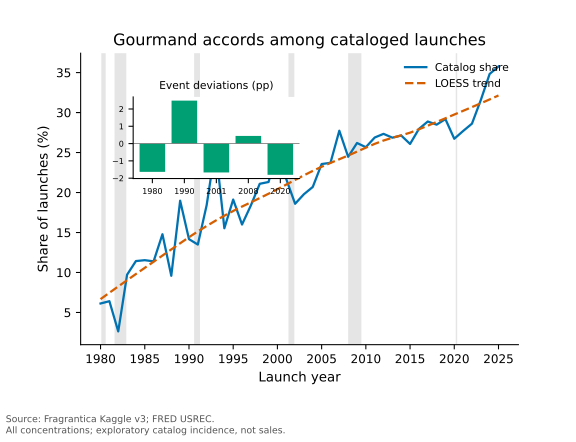
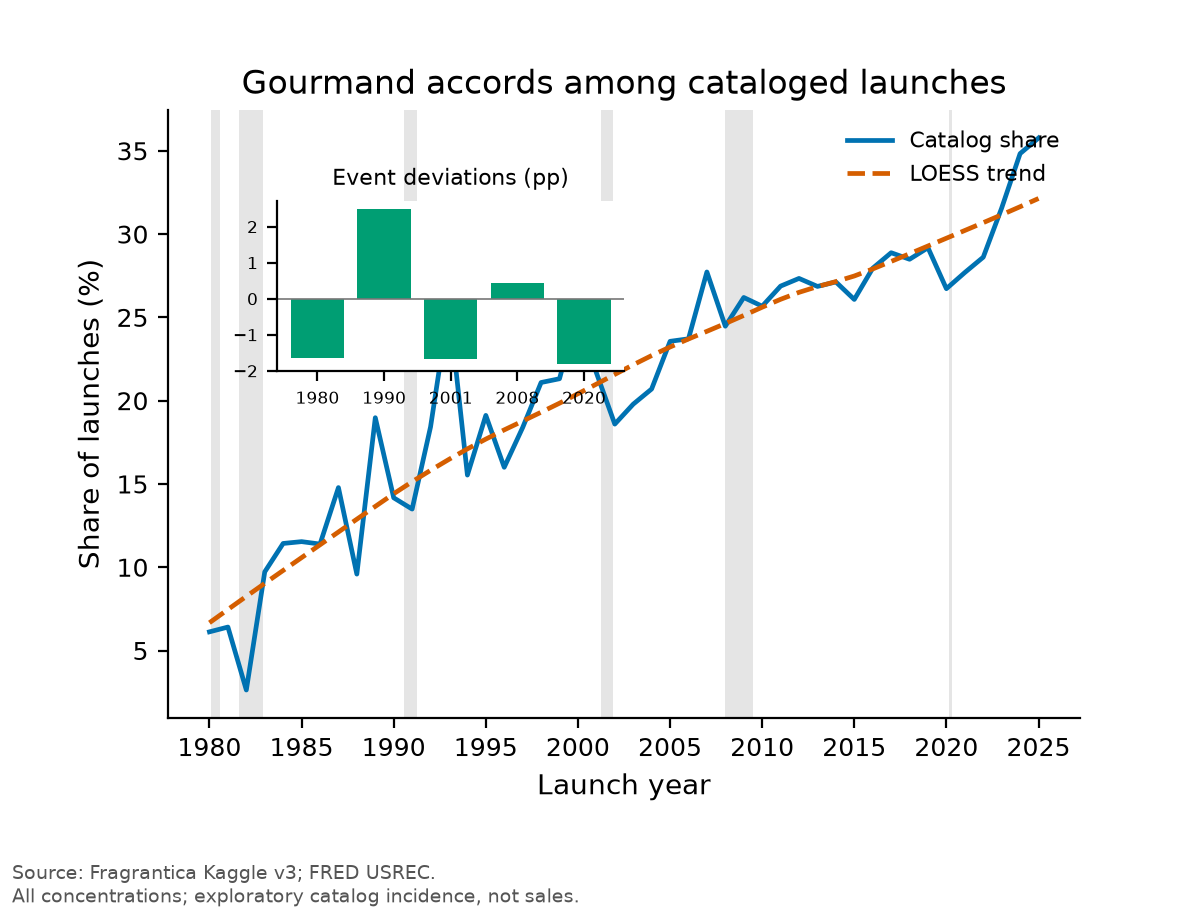
Latest descriptive reading · gourmand launch share relative to trend

Gourmand launches vs trend

+3.6 pp

Observation: December 2025

Weak flanker validation and second-catalog measurement limits

Only 10 of 100 holdout labels were determinate; 90 were unsure. Against those AI-assisted labels, precision was 0.43 and F1 was 0.60. These are not independent human accuracy estimates.

Selected-concentration Parfumo flanker share is zero in every analysis year, making that test unavailable. Source names include years that the frozen base-name rule retains, potentially separating related releases. This is a source-format and classification limitation, not evidence that Parfumo has no flankers.

Explore the evidence

Gourmand launches. Gourmand share among cataloged launches. Catalog composition and missing fields can change over time; the series is not a market sales share.

Gourmand share among cataloged launches. Catalog composition and missing fields can change over time; the series is not a market sales share.

SVG PNG

On a narrow screen, scroll the chart horizontally or open the full-size SVG. The summary below gives the main reading in text.

02 / 12/12 exports collected · Primary analysis unavailable

The Barbell

Are luxury and budget fragrance pulling apart?

The registered data requirements are unmet, so the hypotheses remain untested.

All 12 first-round Google Trends exports are complete. Each of the five budget terms has fewer than 36 active months, and no anchor meets the registered criteria for Round 2. Round 2 was skipped; the primary tests and market reading are unavailable. No primary result is inferred, and no hypothesis is rejected.

12/12 Round 1 exports · data eligibility checkpoint · no primary result

No primary reading available
12 of 12 required search exports verified.

November 2026 research update

A review using Carnegie Mellon University Libraries’ business research guide adds context to each study and identifies data for follow-up tests. CMU Libraries research guide

The Lipstick Test

A Princeton senior thesis reports that perfume diverged from the lipstick effect during the Great Recession. The available abstract covers that single downturn. The registered Sillage test compares a broader cosmetics category with clothing across nine U.S. recessions.

Bottle-Hours

On November 5, 2026, Chanel listed N°5 Eau de Parfum at $190 and Macy’s listed Dior Sauvage Eau de Toilette at $142, both in the 3.4 fl oz size. These checks fall outside the registered sampling window. November wage data were unavailable, so the prices are shown in dollars.

The Comfort Index

Consumer surveys and scent studies give context for fragrance as self-care. The exploratory index measures catalogued launches. A separate launch database could help verify concentration and release dates, subject to data access.

The Barbell

Circana reported that in the first half of 2026, U.S. mass-retail fragrance dollars rose 15% and units rose 7%. Prestige dollars rose 6% and units were flat. The releases group sales by channel. A separate barbell test would need comparable sales for mass, midrange, and prestige brands. The registered search analysis remains unavailable.

How to read this project.

The gauges are a framework for asking related questions. They do not form a single numerical score or establish a causal forecast.

Different measures answer different questions

Spending measures purchasing; search interest measures attention; catalogs measure recorded launches. None can silently stand in for the others.

Register, preserve and disclose

Analysis plans, immutable source vintages and deviations are recorded. Registered tests are separated from exploratory studies and robustness checks.

Uncertainty is part of the result

Reports retain effect sizes, intervals, raw and adjusted p-values, null findings and missing observations. A descriptive reading is not another hypothesis test.

Dates belong to the observations

An export or page update does not make an old observation current. Historical snapshots retain their dates, and missing prices are not interpolated.

Reproduction has a public boundary

The Gauge 1 working paper includes a frozen replication archive. Public summaries and aggregate exports cover the other available studies; private catalog rows, archived retailer pages and credentials are excluded.

Research status and authorship

Independent, AI-assisted research by Ryder Xue. The working paper is self-published and has not undergone journal peer review. These studies describe evidence and its limits.

Read beyond the charts.

Each brief records the question, methods, findings, uncertainty and source vintages. Gauge 1 also has a full working paper and frozen replication package.

01The Lipstick TestResults & methods brief
03The Comfort IndexResults & methods brief

Briefs, source charts and the working paper are in English. Page explanations are available in English and Chinese.

Source families: BEA national accounts; FRED/BLS and NBER macroeconomic series; Fragrantica and Parfumo catalogs; verified archived retailer pages. Gauge-specific attribution and dates are in the briefs and chart notes.

This product uses the FRED® API but is not endorsed or certified by the Federal Reserve Bank of St. Louis.